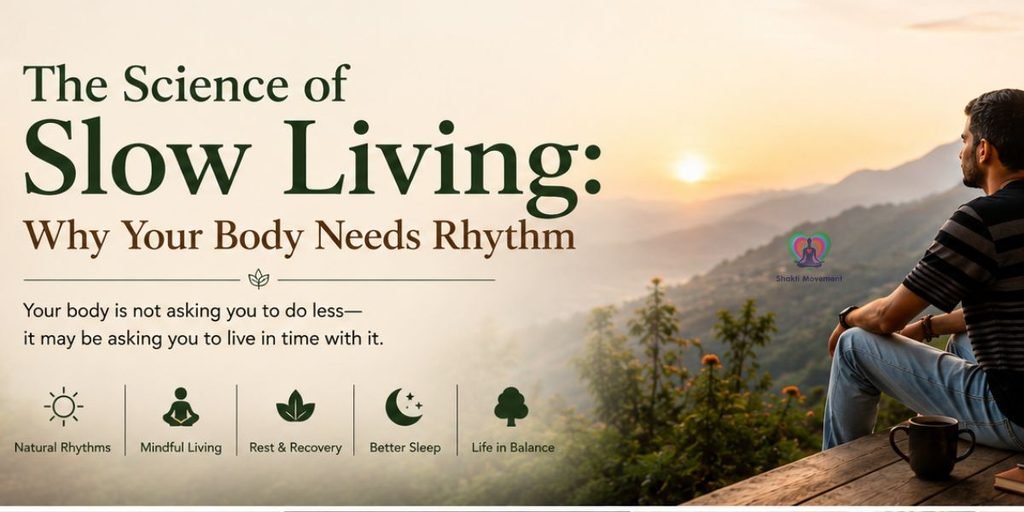

Your body is not asking you to do less — it may be asking you to live in time with it.

For almost fifteen years, I lived in a busy city in Punjab.
I was used to the rhythm of city life.
Work.
Messages.
Traffic.
Classes.
Plans.
Deadlines.
Screens.
There was always something to do.
And when there wasn’t, I usually found something.
For a long time, I thought this was simply what a productive life looked like.
But slowly, I began to notice something:
My life was full, but there was not always enough space to experience it.
That realisation eventually became one of the reasons I moved permanently from city life back to my village in Himachal Pradesh.
I did not move because I wanted to stop working.
I did not move because I had lost my ambition.
I moved because I wanted to understand what it felt like to live differently.
And living here has made me think about something deeper than “slow living.”
It has made me think about rhythm.
Because the more I learn about the human body, the more obvious something becomes:
We are rhythmic beings living in a world that increasingly has no rhythm.
Maybe the deeper question is not, Why are we living so fast?
Maybe it is this:
What happens when our days repeatedly work against the rhythms our bodies depend on?
Your body lives by rhythm
Our bodies do not experience life as one uninterrupted stream.

Sleep has a rhythm. Wakefulness has a rhythm. Hormones rise and fall. Body temperature changes. Alertness changes. Hunger changes. Our nervous system moves between activation and recovery.
One of the best-known examples is the circadian rhythm: the approximately 24-hour biological timing system that helps coordinate sleep, waking, metabolism, hormones, and many other bodily processes.
At the centre of this system is a small region in the brain called the suprachiasmatic nucleus. It receives powerful timing information from light and helps coordinate many of the body’s daily rhythms.
In simple terms:
Your body is constantly trying to understand what time it is.
Light tells it something about day.
Darkness tells it something about night.
Regular routines provide additional cues about when to wake, eat, move, focus, rest, and sleep.
But modern life can make those signals confusing.
We can work at 11 PM.
We can eat at random hours.
We can sleep at different times every night.
We can wake up and immediately look at a bright screen.
The sun can set outside while our artificial world continues as if it is still afternoon.
Perhaps this is one reason slow living feels so attractive to so many people.
Not because we want to become less ambitious.
But because we may be craving clearer boundaries between day and night, work and rest, stimulation and recovery.
Research and expert consensus on light exposure emphasise the value of adequate daylight during the day and lower light exposure in the evening and at night for supporting circadian timing, wakefulness, and sleep.
Your morning does not need to be another performance
Sometimes I wonder whether we have turned mornings into another form of pressure.

Wake up at 5 AM.
Exercise.
Meditate.
Journal.
Read.
Plan.
Visualise.
And by 7 AM, apparently, you should have already won the day.
But your circadian system is not interested in whether you completed a perfect morning routine.
It needs clear time cues.
And one of the strongest cues is daylight.
One simple way to support a clearer daily rhythm is to spend some time outside in the morning.
See daylight.
Move your body gently.
Let your eyes experience the changing light.
Allow your brain to receive a simple message:
The day has begun.
It does not need to become another performance or productivity task.
A short walk, sitting outside with tea, watering plants, or standing on a balcony for a few minutes can be a practical place to begin.
Just experience the morning before immediately handing it over to the internet.
We also need to learn how to end the day
We have become very good at starting.
Not always at ending.
Work finishes, but the phone continues.
Dinner finishes, but the laptop opens.
The body becomes tired, but the mind keeps consuming.
We get into bed and bring the entire digital world with us.
One more message.
One more video.
One more scroll.

Then we wonder why sleep does not arrive easily.
Sleep is not simply a matter of willpower. It emerges from the interaction between the body’s sleep pressure and its circadian timing — both influenced by routines and environmental signals such as light.
Perhaps evenings need something we rarely give them:
A transition.
Less stimulation.
Less work.
Less light.
Less urgency.
More quiet.
Eventually, darkness.
Not because darkness is magical.
But because your biology understands it.
Your brain needs quiet too
Another part of slow living that interests me is attention.

Think about an ordinary day.
You work.
A notification arrives.
You check it.
You return to work.
Another message.
You open Instagram.
You see something interesting.
You return.
Someone calls.
You answer.
You come back again.
Nothing dramatic has happened.
But your attention has been pulled in several directions.
Again and again.
That is tiring.
This is one reason nature has become increasingly interesting in cognitive research. A 2025 systematic review and meta-analysis examining 80 studies and 273 individual outcomes found that exposure to natural environments was associated with small average improvements in cognitive restoration compared with non-natural environments. The most consistent results involved working memory and attentional control, though the findings varied considerably across studies.
This does not mean:
Go to the mountains and your brain will heal.
It means something more realistic and useful:
A change in environment may sometimes help an overloaded mind recover.
Sometimes, after hours of thinking, what we need is not more information.
We need less information.
What I notice in my village
After nearly fifteen years in city life, returning permanently to my village in Himachal Pradesh has changed something very ordinary:

I notice transitions.
Morning feels like morning.
Evening gradually becomes evening.
The light changes.
The sounds change.
The environment becomes quieter.
There are moments when nothing particularly urgent is happening.
At first, those moments felt strange.
Because I had become very good at filling them.
Phone.
Podcast.
Message.
Task.
Another task.
But slowly, I began to appreciate something I had forgotten:
Empty space is not necessarily wasted space.
Sometimes the mind needs it.
Sometimes the body needs it.
Sometimes we need a few moments where nothing is asking anything from us.
The village has not magically solved my life.
I still work.
I still get distracted.
I still have responsibilities.
I still have days when my routine is far from perfect.
But the environment gives me more opportunities to notice how I am living.
And perhaps awareness is where change begins.
Slow does not mean doing nothing
A healthier, slower life is not:
Sit. Scroll. Sleep.
The body needs movement.
It needs strength.
It needs daylight.
It needs challenge.
It needs connection.
It needs rest.
It needs sleep.
Physical activity has substantial health benefits and can also support sleep. The World Health Organization recommends that adults aim for 150–300 minutes of moderate-intensity aerobic activity per week, or 75–150 minutes of vigorous activity, plus muscle-strengthening activities on two or more days each week.
So perhaps the opposite of a fast life is not a sedentary life.
It is a rhythmic life.
Move.
Work.
Eat.
Connect.
Rest.
Sleep.
Repeat.
Effort and recovery.
Focus and release.
Day and night.
Stop trying to optimise every moment
Perhaps this is where slow living becomes less of a lifestyle trend and more of a genuine question about how we want to live.
Can you eat without a screen?
Can you walk without listening to something?
Can you sit without immediately reaching for your phone?
Can you speak to someone without dividing your attention?
Can you let the evening become quiet?
Can you sleep without taking the entire internet into bed?
Can you have a few minutes in your day where nothing needs to be achieved?
You do not need to change your whole life at once.
Start with one rhythm.
Morning daylight.
A daily walk.
A more consistent sleep time.
A screen-free meal.
A quieter evening.
Small signals, repeated consistently, can become a different way of living.
What I was really looking for
When I left city life after nearly fifteen years, I thought I was changing where I lived.
Perhaps I was really changing how I wanted to experience time.
I did not want a life without ambition.
I wanted ambition without constantly feeling rushed.
I did not want less work.
I wanted work to have a place.
I did not want to escape technology.
I wanted technology to have boundaries.
I did not want to stop doing.
I wanted to remember how to be.
Perhaps that is what slow living is really inviting us to consider.
Not:
How can I do less?
But:
How can I live in a way that allows my body, brain, and mind to recover?
Your phone can stay awake all night.
Your work can continue indefinitely.
The internet never needs a break.
You do.
Your body does.
Your brain does.
Your attention does.
Maybe we do not need to slow life down.
Maybe we simply need to give it back its rhythm.
More daylight.
More movement.
More focused attention.
More nature.
More darkness.
More sleep.
More recovery.
More presence.
Not a perfect life.
Just a life that feels a little more human.
A small invitation to begin

If, while reading this, you found yourself thinking, “I think my body has been asking me for something different,” do not rush to fix everything.
Start by listening.
Notice your sleep.
Notice your energy.
Notice your attention.
Notice your relationship with your phone.
Notice your mornings and evenings.
Notice your body.
Notice your environment.
If this reflection makes you realise that your sleep, attention, energy, or relationship with time has been asking for something different, I created a simple Daily Rhythm Self-Reflection Assessment to help you pause and understand where you are starting from.
Begin Your Daily Rhythm Self-Reflection Assessment
You do not need to change everything at once.
Sometimes a different life begins with one small, repeated signal: morning daylight, a walk, a slower meal, a quieter evening, or a more protected bedtime.
Sometimes healing begins much earlier than we think.
It begins when we slow down enough to notice what our life has been trying to tell us.
References:
1. Brown, T. M., Brainard, G. C., Cajochen, C., et al. (2022). Recommendations for daytime, evening, and nighttime indoor light exposure to best support physiology, sleep, and wakefulness in healthy adults.
2. Bell, C. N., et al. (2025). The relationship between nature exposures and attention restoration: A systematic review and meta-analysis. Journal of Environmental Psychology. The review included 80 studies and 273 individual outcomes.
3. World Health Organization. (2020). WHO Guidelines on Physical Activity and Sedentary Behaviour.
4. Lamb, D. (2019). Taking it day-by-day: An exploratory study of adult perspectives on slow living in an urban setting.
Further reading :
– Panda, S. The Circadian Code.A practical introduction to how light, sleep, meals, and daily routines influence the body clock.
– Walker, M. Why We Sleep. An accessible popular-science exploration of sleep and its relationship with learning, mood, health, and performance.
– Honoré, C. In Praise of Slow: How a Worldwide Movement Is Challenging the Cult of Speed. A foundational exploration of the Slow Movement and its focus on choosing a more meaningful pace rather than rejecting ambition.
– Berman, M. Nature and the Mind. A book by an environmental-neuroscience researcher exploring how nature affects attention, brain development, and mental wellbeing.
– Burkeman, O. Four Thousand Weeks: Time Management for Mortals. A thoughtful book about limits, productivity culture, attention, and living meaningfully within a finite life.

No Comments yet.