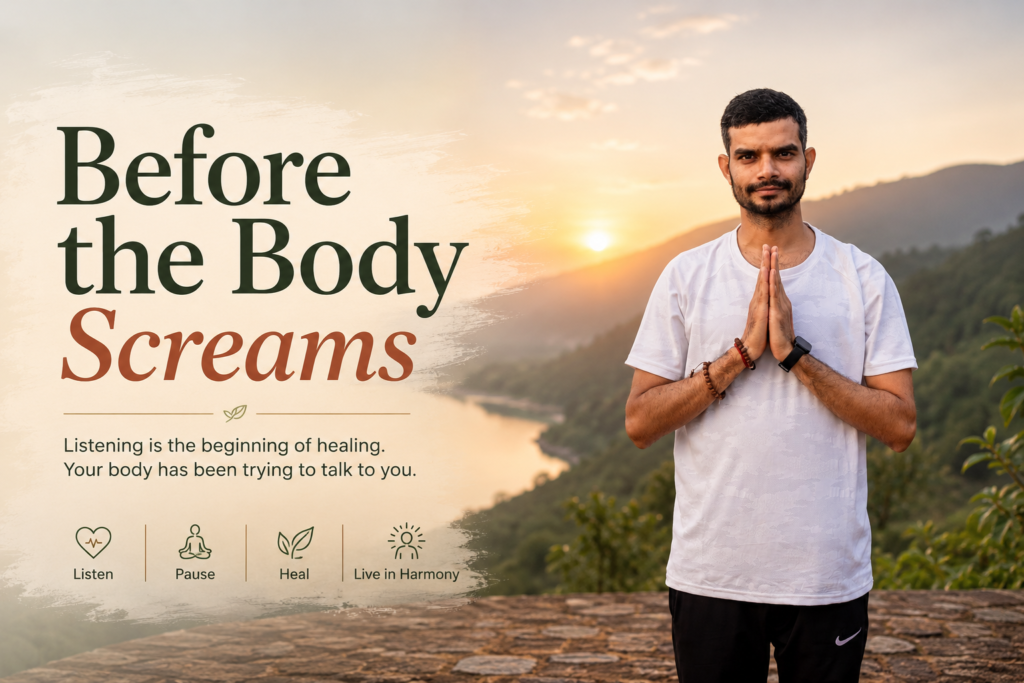

Learning to Hear the Whispers That Guide Our Health, Restore Our Peace, and Lead Us Back to Ourselves
“The body whispers before it screams. It speaks through hunger before depletion, through fatigue before burnout, through tension before pain, and through emotion before suffering. Healing begins the moment we choose to listen.”
The Day I Realized I Had Stopped Listening to Myself
A few years ago, I found myself asking a simple yet uncomfortable question: How can I help others heal if I have stopped listening to myself?
At that stage of my life, my days were entirely full. I was teaching yoga, guiding meditation sessions, planning workshops, meeting people, replying to messages, creating content, and trying my best to support everyone who came to me. From the outside, everything looked meaningful — I was doing what I loved and living my purpose. Yet, somewhere in the middle of serving others, I had slowly drifted away from serving myself.
I postponed meals because there was always one more task to finish. I ignored tiredness because I believed I could rest later. When my shoulders felt tight or my lower back ached, I stretched for a moment and carried on. When my mind felt overwhelmed, I told myself to be stronger. I honestly believed this was what dedication looked like. Looking back today, I realize it wasn’t dedication — it was disconnection.
The most surprising part was that nothing happened overnight. There was no dramatic moment, no sudden collapse, and no life-changing diagnosis. Instead, it happened quietly through ordinary, unexamined choices:
- One postponed meal.
- One missed night’s sleep.
- One ignored headache.
- One more promise that I would take care of myself once life became less busy.
But life rarely becomes less busy on its own. There is always another responsibility, another student, another project, or another person who needs us. If we are not careful, we slowly become available to everyone except ourselves.
We Learn to Listen to the World Before We Learn to Listen to Ourselves
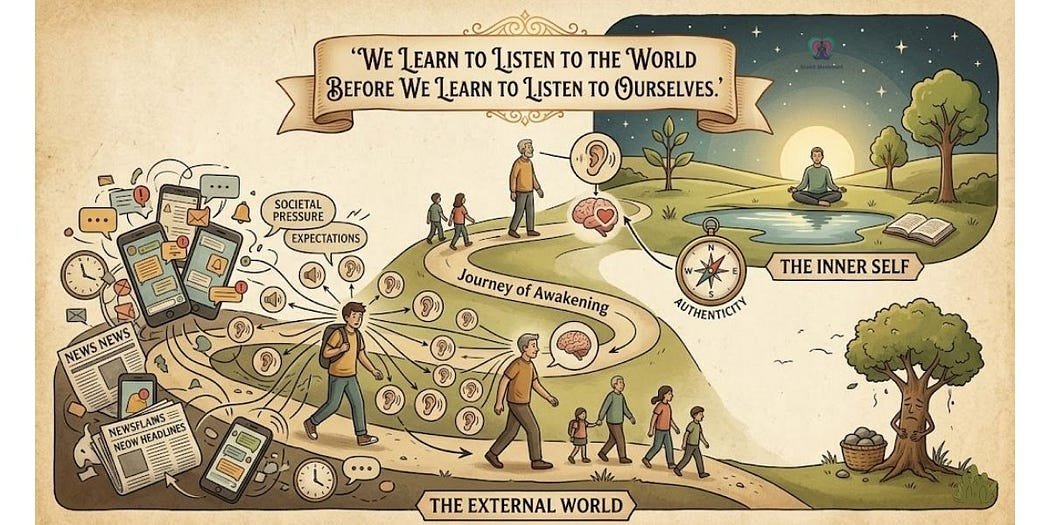
When we are children, listening to the body is effortless. We eat when we are hungry, cry when something hurts, sleep when we are tired, and move simply because movement feels natural. Our body and our awareness exist in natural harmony.
Then life begins teaching us different lessons. We learn to follow the clock instead of our natural rhythm. We finish work before eating, answer notifications before noticing our breath, and silence our emotions because they are inconvenient. We wear busyness like a badge of honor. Slowly, we become highly successful at managing life while becoming increasingly disconnected from living it.
The body, however, never stops communicating. It whispers through fatigue, restlessness, tight shoulders, shallow breathing, poor sleep, digestive discomfort, irritability, and that quiet feeling that something isn’t quite right. These are not inconveniences — they are invitations to pay attention. The body isn’t interrupting our life; it is part of the conversation.
The Conversation That Changed Everything
During this period of my life, I had a conversation with my spiritual mentor, Kamakshi Ma’am. We were talking about life, service, and the heavy feeling of constantly giving our energy to others. In the middle of our conversation, she said something so simple that I almost missed its depth:
“Before you are available to the world, be available to yourself.”

I carried those words with me for days. The more I reflected on them, the more I realized they described my life perfectly. Every morning, I was making myself available to my phone, my students, my responsibilities, and the expectations of the world. Yet, I had forgotten to become available to myself.
That single sentence quietly transformed the way I began every day. From that morning onward, I made a promise. Before I entered a coaching session, stepped onto the yoga mat to teach, or replied to a single message — before I became available to anyone else — I would first become available to myself.
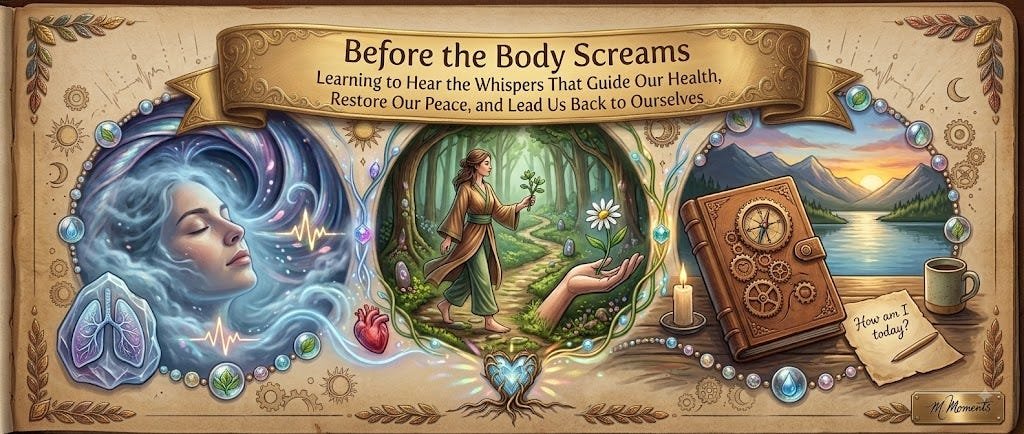
I began intentional mornings of sitting in silence, breathing consciously, practicing yoga, meditating, and praying. Sometimes I would write in my journal; sometimes I would simply watch the sunrise with a cup of warm water in my hands. Then, instead of asking “Who needs me today?”, I began asking a much simpler question: “How am I today?”
It sounds like a small change. It wasn’t. It changed everything.
The Body Was Never My Enemy
For years, I believed my body was slowing me down. Fatigue interrupted my productivity, pain interfered with my plans, and stress made life more difficult. Today, I see those experiences through a completely different lens.
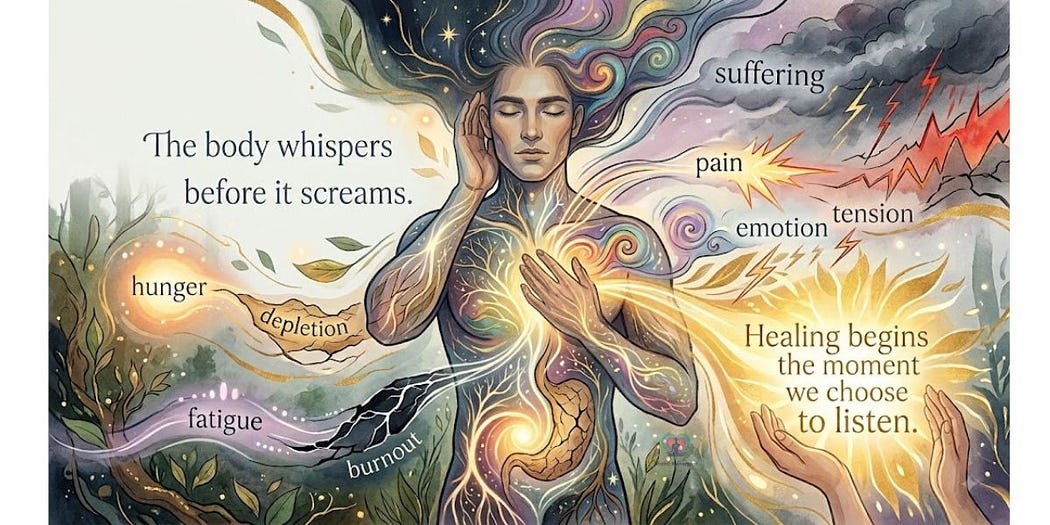
Fatigue wasn’t trying to stop me; it was asking me to recover. Pain wasn’t punishing me; it was asking for my attention. Stress wasn’t my enemy; it was showing me that the way I was living needed to be examined. The body had never been working against me — it had been communicating with me all along. I simply hadn’t learned its language.
That realization changed my relationship with health forever. I stopped asking, “How can I make my body do more?” Instead, I began asking, “What is my body trying to teach me?”
Perhaps that is where healing truly begins: not when we become perfect or when every symptom disappears, but when curiosity becomes stronger than judgment, listening becomes more important than pushing, and awareness becomes more valuable than achievement.
The Science of the Whispers
What spiritual traditions describe as listening to inner wisdom, modern neuroscience studies through the concept of interoception. Interoception is our biological ability to sense, interpret, and become aware of signals arising from within the body — hunger, thirst, heartbeat, breathing, temperature, muscle tension, fatigue, and digestion.
Think of it as your body’s internal dashboard. Just as a car dashboard gives you information about fuel, temperature, or engine function, interoception provides your brain with real-time data about what is happening inside your physical system.
In his foundational work on interoception, neuroscientist Dr. A.D. (Bud) Craig described how the brain receives and represents these signals through the insular cortex, forming the neural map for how we experience physical and emotional states. This gave me a new way of understanding my own experience: my body had not suddenly started speaking; it had been communicating all along. The problem was that I had become too busy to listen.
The Nervous System Can Remain on High Alert
When demands continue without adequate recovery, the body’s stress systems remain chronically activated. You may recognize this as a mind that won’t slow down, muscles that remain perpetually tense, difficulty relaxing, disrupted sleep, or an underlying state of constant alertness. You may be physically sitting still, yet internally you still feel as though you are running a marathon.
This is why simply being told to “take a break” doesn’t always feel restorative. Sometimes the body needs more than an empty calendar — it needs an opportunity for genuine physiological recovery.
The Body Carries the Effects of What We Don’t Process
In The Body Keeps the Score, psychiatrist and researcher Dr. Bessel van der Kolk describes how overwhelming experiences and chronic stress directly influence the nervous system and bodily tissues. This doesn’t mean that every physical symptom is caused by stress, but it highlights that our physical and emotional lives are deeply interconnected.
The stress we experience is never just a thought floating in the mind. It manifests physically — influencing sleep quality, muscle tension, digestive function, breathing patterns, energy levels, and emotional regulation. The body keeps giving us information; the question is whether we are paying attention.
The Whisper Can Become Harder to Ignore
At first, the signals are subtle: a little extra fatigue, a tight jaw, a restless night, a shorter temper, skipping meals, feeling constantly rushed, or losing interest in things that once brought joy. We tell ourselves, “I’ll deal with it later.” Sometimes we push through like this for months — or even years.
Eventually, those signals become impossible to ignore. Exhaustion becomes persistent, sleep becomes severely disrupted, stress begins straining relationships, and the activities that once brought pleasure feel like heavy obligations. The body demands attention in ways we can no longer postpone.
This is why listening early matters so deeply. The goal is not to wait until the body screams; the goal is to become sensitive enough to hear the whisper.
This is where modern science and the ancient practice of yoga meet beautifully. Yoga asks us to observe, to breathe, to become aware, and to study ourselves — to notice what is happening within before automatically reacting to what is happening around us. Science gives us another language for understanding that exact same experience. Different words, different entry points, but the invitation is identical: Listen inwardly. The body is not an obstacle standing between you and your life; it is part of the conversation.
When Listening Becomes an Act of Ahimsa
The more I learned to listen to my body, the more I began to understand something I had previously overlooked in my practice: listening itself is an act of compassion.

One of the principles that has touched me most deeply through yoga is Ahimsa — non-harming. For years, I understood Ahimsa mainly as an external practice governing how I treated other people: speaking with kindness, avoiding unnecessary harm, and responding with compassion. But eventually, I had to ask myself a more uncomfortable question: What if Ahimsa also asks me to consider how I treat myself?
What happens when I repeatedly ignore hunger, push through exhaustion, override pain because there is still work to finish, or silence an emotion because I don’t have time to feel it? I may not be intentionally hurting myself, but I am still living in a way that continually overrides what my body is asking for.
That shift changed my understanding of non-harming completely. Sometimes Ahimsa is not about doing something more; it is about stopping the constant overriding — stopping long enough to eat, to breathe, to rest, and to say, “This is too much for me today.”
Then came another yogic principle that illuminated my path: Svadhyaya — self-study. Traditionally associated with studying sacred teachings, Svadhyaya in daily practice means becoming a sincere student of your own patterns.
Not judging them — studying them. What happens to my breathing when I am anxious? What happens to my shoulders when I take on too much? What happens to my appetite when I am stressed? What happens when I keep saying yes when everything inside me wants to say no?
These questions created space between sensation and reaction. Within that space, I realized my body wasn’t asking me to become perfect; it was asking me to become present. Ahimsa teaches us to stop overriding what asks for care, while Svadhyaya gives us the curiosity to understand what that care needs to look like.
Healing Begins With Small Moments
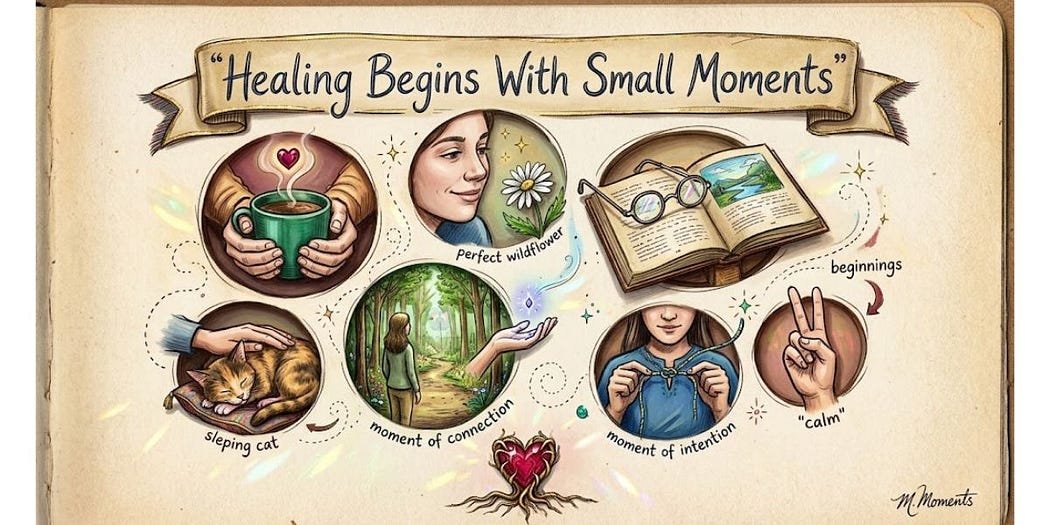
People often ask me, “What is the first step toward healing?” Many expect me to recommend a special breathing technique, an advanced yoga posture, a meditation practice, or a strict detox program. Those things certainly have their place, but today my answer is much simpler: Start listening.
Listen before trying to fix. Listen before trying to improve. Listen before trying to optimize your life. We cannot care for something we no longer notice.
Healing often begins in very ordinary moments: drinking water when the body asks for it, eating a meal without rushing, standing up after sitting for too long, taking five slow breaths before reacting in frustration, going to bed when tired instead of scrolling for another thirty minutes, or choosing to say “no” when every part of you is already exhausted.
These actions may appear insignificant, yet our lives are not transformed by extraordinary isolated events. They are transformed by ordinary choices repeated with conscious awareness. Every small act of listening becomes a small act of care, every act of care builds a new habit, and every new habit quietly changes the relationship you have with yourself.
Reclaiming Your Rhythm: Three Simple Micro-Habits
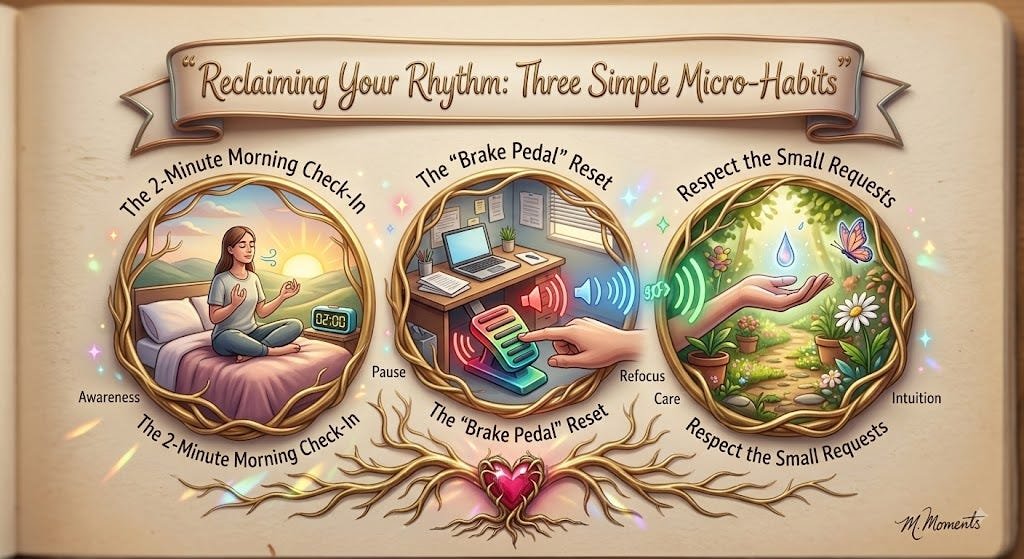
Healing does not require burning down your schedule or escaping to a remote retreat. It can begin with small moments of awareness woven into the life you are already living. You don’t need another complicated routine; you simply need a few moments to stop, listen, and respond.
1. The 2-Minute Morning Check-In
Before picking up your phone or opening your emails, sit quietly for two minutes. Take a few natural breaths, and ask yourself one simple, non-judgmental question: “How does my body feel right now?” Don’t try to change anything. Just notice. Are you tired? Restless? Heavy? Light? Calm? Tense? The purpose isn’t to find the “right” answer — it is to begin the conversation.
2. The “Brake Pedal” Reset
Three times during the day, pause for a moment (set a gentle phone reminder if helpful). Unclench your jaw, let your shoulders drop, and notice your breathing. Take four slow, comfortable breaths, allowing the exhalation to be slightly longer than the inhalation. You don’t need to escape your day; you simply need to give yourself a moment to reconnect.
3. Respect the Small Requests
Your body rarely begins with a demand — it begins with a small request. Drink water when you notice thirst. Stand up when your back begins to feel tight. Rest when fatigue appears instead of pushing through. Eat when you are hungry rather than postponing nourishment. And when your energy is genuinely depleted, practice saying a gentle and respectful “no.”
One pause. One breath. One nourishing meal. One moment of rest. One honest “no.” Over time, these small choices teach your body a vital truth: I am listening now.
Coming Home to Yourself
Today, my life is still full. I continue teaching, learning, and serving. Responsibilities have not disappeared, challenges still arrive, and there are certainly days when I move too fast or forget to pause. The difference is that I notice much sooner. I have learned to recognize the whispers before they become screams.
When my breathing becomes shallow, I pause. When my shoulders tighten, I ask what burden I have been carrying. When my mind becomes restless, I return to my breath instead of trying to control every thought. When my body asks for rest, I no longer see it as weakness — I see it as wisdom.
Health is not about controlling the body. It is about developing a relationship with it — built on trust instead of force, curiosity instead of judgment, and awareness instead of constant achievement. Looking back, I realize I didn’t need to become someone new. I simply needed to come home to someone I had slowly forgotten: myself.
An Invitation to Pause
Before you close this article, I invite you to do something simple right now.
Pause for a moment. Take one slow, gentle breath. Without changing anything, simply notice your body — your shoulders, your jaw, your breathing, your heartbeat, your energy.
Then ask yourself one question: “What has my body been trying to tell me that I have been too busy to hear?”
Don’t force an answer. Simply listen. You may discover that your body has never been working against you — it has been patiently giving you information all along. Perhaps today is not the day you transform your entire life. Perhaps today is simply the day you begin listening again.
Because before the body screams, it whispers. And healing begins the moment we choose to hear those whispers.
Before You Leave…
If this article resonated with you, don’t ignore what you are feeling right now. Burnout rarely happens overnight — it develops quietly through prolonged stress, inadequate recovery, disrupted sleep, emotional exhaustion, and difficulty disconnecting from ongoing demands.
I’ve created the free Wholistic You™ Burnout & Body Awareness Assessment to help you pause and understand the physiological and emotional patterns you may be experiencing.
In just a few minutes, you’ll reflect on your:
- Energy and recovery indicators
- Sleep quality and daily rhythm
- Nourishment and somatic signals
- Emotional well-being and mental load
- Inner awareness and relationship with yourself
This assessment is a self-awareness tool, not a medical diagnosis. Your result isn’t a label — it is a clear starting point.
👉 Take the Free Wholistic You™ Burnout & Body Awareness Assessment
Remember: awareness is the first step. The sooner we learn to hear the whispers, the less likely we are to ignore the signals that deserve our attention.

References & Resources
Scientific Research
- Craig, A. D. (Bud). (2002). How do you feel? Interoception: The sense of the physiological condition of the body. Nature Reviews Neuroscience, 3, 655–666.
- Craig, A. D. (Bud). (2009). How do you feel — now? The anterior insula and human awareness. Nature Reviews Neuroscience, 10, 59–70.
- Toker, S., & Melamed, S. Stress, Recovery, Sleep, and Burnout.
Books & Further Reading
- van der Kolk, Bessel. The Body Keeps the Score: Brain, Mind, and Body in the Healing of Trauma.
- Porges, Stephen W. The Polyvagal Theory: Neurophysiological Foundations of Emotions, Attachment, Communication, and Self-Regulation.
- Damasio, Antonio. The Feeling of What Happens: Body and Emotion in the Making of Consciousness.
- Kabat-Zinn, Jon. Full Catastrophe Living: Using the Wisdom of Your Body and Mind to Face Stress, Pain, and Illness.
- Sapolsky, Robert M. Why Zebras Don’t Get Ulcers.
Classical Yoga Texts
- Yoga Sutras of Patanjali
- Bhagavad Gita
- Hatha Yoga Pradipika
A Gentle Note: This article is intended for educational and self-reflective purposes. It is not a substitute for professional medical, psychological, or mental health care. If you are experiencing persistent or worsening physical symptoms, severe exhaustion, or significant emotional distress, please seek guidance from an appropriately qualified healthcare professional.


No Comments yet.